|
|
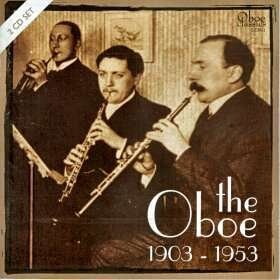
ID: CC2012 (EAN: 5023581201227) | 2 CD | ADD Vydano: 2005
- LABEL:
- Oboe Classics
- Kolekce:
- Instrumental
- Podkolekce:
- Oboe
- Skladatel:
- BACH, Johann Christian | BEETHOVEN, Ludwig Van | BRAHMS, Johannes | COLIN, Charles | HÄNDEL, Georg Friedrich | MILHAUD, Darius | MOZART, Wolfgang Amadeus | NIELSEN, Carl | RIMSKY-KORSAKOV, Nikolay Andreyevich | SATIE, Erik | SCHUMANN, Robert | TCHAIKOVSKY, Pyotr Il'yich
-
Interpreti:
- ADDIMANDO, Caesar (oboe) | BLANCHARD, Georges (oboe) | BLEUZET, Louis (oboe) | BUSSCHER, Henri de (oboe) | FELUMB, Svend Christian (oboe) | FLEMMING, Fritz (oboe) | FONTEYN, Joseph (oboe) | FOREMAN, Arthur (oboe) | GAUDARD, Louis (oboe) | GILLET, Fernand (oboe) | GILLET, Georges (oboe) | GOOSSENS, Léon (oboe) | GROMER, Louis (oboe) | KAMESCH, Hans (oboe) | KAUTSKY, Manfred (oboe) | LONGY, Georges | LORD, Roger (oboe) | MERCIER, Louis (oboe) | MOREL, Myrtile (oboe) | PRIOR, Ferdinand (oboe) | SUTCLIFFE, Sidney (oboe) | TABUTEAU, Marcel (oboe) | WANN, Lois (oboe)
- Dal informace:
The 24-page CD booklet has a 6,000 word programme note in English by the compiler Geoffrey Burgess�with a description of each performer, each track, and many unusual photographs.
Introduction by compiler Geoffrey Burgess: ��It would be hard to claim the oboe as a main player in the rise of the phonograph in the early years of the twentieth century. In both contemporary literature and retrospective histories, oboists barely rate a mention alongside the Carusos, Melbas, Elgars and Kreislers, and the lack of a comprehensive discography or historic anthology backs this up. But why have early oboe recordings been silent for so long? It is time to discredit the popular belief that of the few recordings of oboists that have survived, most are worthless from a musical standpoint. ��While not featured as frequently as most other instruments, the oboe was not entirely silent in the recording studio: however, the problem lies much more in how and where to retrieve those distant echoes. Catalogues, reviews and the like cite specific recordings, but this is only a beginning. The next and harder step is to track down serviceable copies of this material which in most instances was considered of merely ephemeral value. ��We have to consider ourselves lucky with what has survived. Contrary to what we might think, the scarcity of oboe recordings is not a reflection of the difficulties encountered in capturing its tone. Even the earliest acoustic recordings demonstrate that, with the player projecting directly into the recording horn, the oboe sounded better than many other instruments. The reason for the scant presence of the oboe on disc has to do more with its musical and cultural persona. Just as now, the recording industry in the early decades of the twentieth century was dictated by popular taste. Not only did the Classical selections in gramophone catalogues constitute a small percentage of the total offerings, but they were dominated by operatic excerpts and rousing tunes performed by bands. In such a climate the oboe was not exactly a winner, rather it was considered a novelty, of interest to the refined connoisseur. ��It’s not needles, but the records themselves that need hunting down in the haystacks of archival repositaries and collectors’ attics. Artists’ names and instruments were given only rarely on the discs. Manufacturers’ catalogues can help but it is often necessary to resort to intelligent guesswork. ��According to the renowned audiofile Melvin Harris, it was Louis Gaudard who made the earliest oboe recording in 1899, but this claim is still to be substantiated. The oldest surviving recordings date from the first decade of the 20th century, with showy solos of ephemeral appeal usually accompanied by band, orchestra or, more rarely, piano. ��Despite the scant examples, we are blessed with multiple recordings of some favorites such as Une Soirée prčs du lac and standard orchestral repertoire like the overture to Guillaume Tell. These multiple versions allow direct comparison between different oboists, although it should always be borne in mind that the different settings and the recording process contributed in no small measure to the total sonic record. ��This anthology spans the acoustic and electric eras and all recordings are monoaural. Léon Goossens was the most widely recorded oboist of the first half of the 20th century, but otherwise, all of the oboists featured in this anthology were active before the rise of the oboe “heroes” still familiar today - André Lardrot, Pierre Pierlot, Heinz Holliger, etc. Many were celebrated in their own day, but most are now forgotten. We have intentionally avoided duplicating the already copious quantity of re-released material. Oboists like Roger Lamorlette, who can be heard playing Poulenc’s trio for oboe, bassoon and piano with the composer, have been omitted, and well known players like Goossens and Tabuteau whose work is already widely available, are represented only by noteworthy selections hitherto unavailable. ��There is no natural terminus ad quem for this anthology. Stylistic changes in oboe playing tended to overlap advances in recording technology in complex ways. Still, it seems appropriate to draw the line at the mid century with the dawn of the LP era with the Viennese recording of Beethoven’s variations on La ci darem (CD II track 21). ��Direct contact with these remarkable performances from the past is still hampered by the limitations of the available recording technology and the state of preservation of this delicate material. Most of the original recordings used here are in an exceptionally fragile state and the audio quality of many is quite simply deplorable. Any wax cylinder or shellac disc that has miraculously survived the junk yard inevitably bears the signs of abuse - damaged through overuse, poor storage conditions, or the jostle of the flea market before falling into the hands of a responsible collector. Every effort has been made to locate clean copies, but in some cases there was simply no choice. ��To understand these vestiges of players from the past, we have to learn to listen “through” the recording technology. Most early recordings have what today would be an unacceptable signal-to-noise ratio. The distraction of surface noise and crackles and limited frequency response and can hinder drawing conclusions on individual players’ tone. Most acoustic recordings registered a relatively narrow band of frequencies from 1000-3000Hz. With the introduction of microphones this was expanded to 200-6000Hz, but this is still far short of present standards which were set in the stereo LP era at 20Hz-20KHz. To those used to digital stereo, the monoaural configuration of early recordings may seem one-dimensional and, particularly in the case of acoustic recordings, the insensitivity of the technology to dynamics often obliterated nuance, and can also give a false sense of balance. ��At the same time we must listen “with” the technology. That is, we must learn to respond to what the technology could register faithfully - tempo, intonation, vibrato and questions of ensemble - always mindful that, once in the recording studio, players may have had to make adjustments from their regular practices. Up to the use of magnetic tape in the recording process in the 1940s, all recordings were “live” in the sense that virtually no editing was possible. Realizing that durations of 2 to 4 minutes (the length of a side of a disc) were recorded as complete takes makes it easier to forgive occasional slips - indeed, it should enhance our admiration for these players. ��It is always dangerous to draw general conclusions from limited data, so rather than viewing these recordings as documents of the essential characteristics of each oboist, it is wiser to treat them as “snapshots” of unique performances. Out-of-focus or underdeveloped due to the shortcomings of the recording apparatus, these passing glimpses are the closest we can get to the artistry of these lost musicians. ��Despite this material’s limitations, it’s revelations are manifold. The recordings of Georges Gillet CD I track 2) and his pupils (Gaudard, CD 1 track7; Mercier, CD I track 8; Brun, CD I track 9; Longy, CD I track 11; and Bleuzet, CD II tracks 5-8) show that prior to World War II French players did not all cultivate the bright tone typical of the younger players of the Paris Conservatoire school. We can appreciate why Tabuteau praised Bruno Labate (CD I track 16), and why Goossens could not have failed to have been impressed by Henri de Busscher’s playing (CD II tracks 13-15). The different performances of the J.C. Bach Sinfonia, Brahms’ Violin Concerto and the Beethoven Variations provide invaluable comparisons of different schools of oboe playing.
CD 1
|
| Caesar Addimando, oboe | | | 1. | Carmen, Petite Mignon (1908) | 2:10 | | | Georges Gillet, oboe (c1905) | | | 2. | Guillaume Tell | 3:02 | | | 'Giorgio' (1906) | | | 3. | ROSSINI, Gioacchino (Antonio) (1792-1868), Guillaume Tell | 3:05 | | | Housset | | | 4. | Huguenin, La nuit de Noël (1903) | 2:12 | | | Joseph Fonteyn, oboe (1875-?) | | | 5. | Guilhaud, First Concertino | 2:29 | | | 6. | Farandole (c1910) | 2:54 | | | Louis Gaudard, oboe (c 1910) | | | 7. | Xavier Leroux, Une Soirée prés du lac | 2:54 | | | Louis Mercier, oboe (c1910) | | | 8. | Leroux, Une Soirée prés du lac | 4:30 | | | Paul-Gustave Brun, oboe (c1926) | | | 9. | Leroux, Une Soirée prés du lac | 3:07 | | | Arthur Foreman, oboe | | | 10. | SCHUMANN, Robert (1810-1856), Romance No. 1 (1911) | 2:58 | | | Georges Longy, oboe | | | 11. | COLIN, Charles (1832-1881), Concertino in D, Andante and Polonaise (1914) | 3:44 | | | Léon Goossens, oboe | | | MOZART, Wolfgang Amadeus (1756-1791), Oboe Quartet K370 (1926) | | | 12. | Allegro | 4:55 | | | 13. | Adagio | 3:14 | | | 14. | Rondeau | 4:34 | | | Georges Blanchard, oboe | | | 15. | BACH, Johann Christian (1735-1782), Sinfonia in Bb, Op. 18/2 | 4:09 | | | Bruno Labate, oboe | | | 16. | BACH, Johann Christian (1735-1782), Sinfonia in Bb, Op. 18/2 | 4:18 | | | Anon oboist | | | 17. | BACH, Johann Christian (1735-1782), Sinfonia in Bb, Op. 18/2 | 6:14 | | | Fernand Gillet, oboe | | | 18. | SATIE, Erik (1866-1925), Gymnopédie 1 (1930) | 4:21 | | | Svend Christian Felumb, oboe | | | 19. | NIELSEN, Carl (1865-1931), Romance (1937) | 3:17 | | | 20. | NIELSEN, Carl (1865-1931), Humoresque (1937) | 2:40 | |
CD 2
|
| Myrtile Morel, oboe | | | MILHAUD, Darius (1892-1974), Suite d'aprés Corrette (1938) | | | 1. | Entrée et Rondeau | 1:27 | | | 2. | Tambourin | 0:36 | | | 3. | Musette | 1:00 | | | 4. | Sérénade | 1:12 | | | Louis Bleuzet, oboe | | | Mihalovici, Sonatine Op 13 pour hautbois et piano (1939) | | | 5. | Moderato: Pastorale | 3:52 | | | 6. | Vivo: Scherzo | 2:39 | | | 7. | Lento: Notturno | 3:43 | | | 8. | Vivi e gioccoso: Rondo | 4:13 | | | Louis Gromer, oboe | | | HÄNDEL, Georg Friedrich (1685-1759), Sonata in F (c1940) | | | 9. | Largo | 2:22 | | | 10. | Allegro | 1:31 | | | 11. | Adagio | 1:19 | | | 12. | Allegro | 1:55 | | | Henri de Busscher, oboe | | | 13. | TCHAIKOVSKY, Pyotr Il'yich (1840-1893), 4th Symphony | 1:16 | | | 14. | RIMSKY-KORSAKOV, Nikolay Andreyevich (1844-1908), Schéhérézade | 1:49 | | | 15. | BRAHMS, Johannes (1833-1897), Violin Concerto 2nd movt (excerpts, 1940s) | 2:49 | | | Fritz Flemming, oboe (1927) | | | 16. | BRAHMS, Johannes (1833-1897), Violin Concerto 2nd movt | 2:11 | | | Léon Goossens, oboe (1936) | | | 17. | BRAHMS, Johannes (1833-1897), Violin Concerto 2nd movt | 2:19 | | | Marcel Tabuteau, oboe (1945) | | | 18. | BRAHMS, Johannes (1833-1897), Violin Concerto opening of 2nd movement | 2:35 | | | Lois Wann, Ferdinand Prior (oboes) and Engelbert Brenner (cor anglais), (1939) | | | 19. | BEETHOVEN, Ludwig van (1770-1827), Variations on "La ci darem" | 9:54 | | | Sidney Sutcliffe, Roger Lord (oboes) and Natalie James (cor anglais), (1951) | | | 20. | BEETHOVEN, Ludwig van (1770-1827), Variations on "La ci darem" | 9:47 | | | Hans Kamesch, Manfred Kautsky (oboes) and Hans Hadamowsky (cor anglais), (1953) | | | 21. | BEETHOVEN, Ludwig van (1770-1827), Variations on "La ci darem" | 10:28 | | "It should be in the collection of everyone who loves the oboe, whether professional or amateur. Oboe Classics deserves our gratitude for bringing back to life these great ghosts of the past."
Neil Black, Double Reed News (UK)
"Generally speaking, the larger the sampling, the more meaningful the effort. One is thus very glad to have no less than 140 minutes of recorded oboe playing from eight different countries over a full half-century recorded here."
Michael Finkelman, The Double Reed (USA)
"My first salvo is a word of praise to the 'backroom boys' [Lani Spahr, for the transfers] - like translators they should be honoured. My second is to Geoffrey Burgess whose notes are fulsome and full of the kind of specialist detail that enhances a historical project such as this. Biographical detail fuses with technical, tonal and expressive analysis in a compact and articulate way."
Jonathan Woolf, Classical Music Web
25.00 eur Docasne neni na skladem
|
|